by | Feb 18, 2022 | Computer Networks, Technical
Topology refers to the shape of a network. The way different nodes in a network are connected to each other and the way they communicate with each other are determined by the network’s topology. The choice of topology is dependent upon on two factors.
1) The type and the number of equipment being used
2) Cost
The various Computer networks topologies and their working are given below.
- Mesh
- Star
- Ring
- Bus
- Hybrid
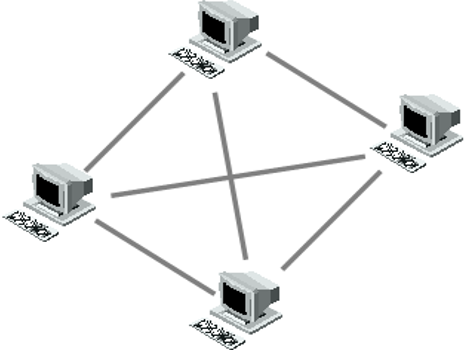
a) Mesh Topology :
In a mesh topology, each device/PC is connected to every other device/PC in the network by its own dedicated cable. A network with ‘n’ nodes, will need n(n-1)/2 links to connect form a mesh topology. The below figure has 4 nodes, which means it will require 6 dedicated links to form a mesh topology.
Advantages of this topology :
- Mesh topology boasts the highest fault tolerance of all of the network topologies as data is transferred among the devices through dedicated channels or links.
- More security and privacy
Disadvantages of this topology :
- Installation and configuration are difficult.
- Since each connection needs its own cable a Mesh topology can get very expensive.
- Cost of maintenance is high.
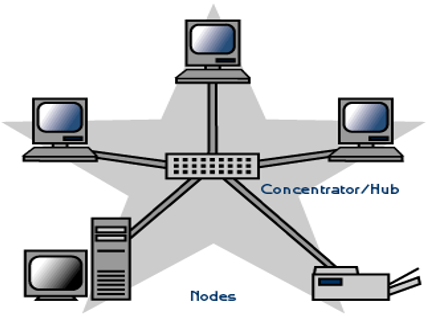
b) Star Topology :
A physical Star topology connects the devices via a centralized unit such as a Hub or Switch. Nodes communicate across the network by passing data through this central device/unit.
Advantages of star topology :
- Single computer failure doesn’t bring down the whole network.
- Adding new devices to a Star network is very simple compared to in any other topologies.
- When connecting or removing devices, no disruptions occur.
- Centralised network/hub monitoring
- Easy to troubleshoot
Disadvantages of this topology :
- If the central device fails, then the whole network fails.
- Compared to the bus topology, a star network generally requires more cable.
- Star topology is more expensive than linear bus topologies because the cost of the central device is high.
c) Bus Topology :
In Bus topology, all devices are connected to a central cable, called the bus or backbone. Both ends of the network must be terminated with a terminator. A barrel connector can be used to extend the network. The backbone functions as a shared communication medium. Device wanting to communicate with another device on the network sends a message onto the backbone. The message is heard by all stations, but only the intended recipient actually accepts and processes the message. Terminator absorbs frames at end of medium

Example:
In the below example, Station C want to transmit a frame of data to station A.

Advantages of this topology :
- Simple, easy to use and construct
- Requires least amount of cable (less expensive)
Problems with this topology :
- A faulty cable will take the entire LAN down
- Difficult to troubleshoot
- Heavy network traffic can slow bus considerably
d) Ring Topology :
In this topology, all devices are connected to one another in the shape of a closed loop, so that each device is connected directly to two other devices, one on either side of it. Data is passed one way from device to device. A short message (called a token) is circulated around the ring, being passed from station to station. The token originates from a controller or master station which inserts it into the ring. A station which wants to transmit waits for the token to arrive. When the token arrives, the station changes it from a token to a connector message and appends its message. This new message is then placed on the outgoing side of the ring.
Each station passes on received tokens if they have nothing to transmit. They monitor connector messages to see if the message is addressed to them. If connector messages are addressed to them, they copy the message, modify it to signify its receipt, then send it on around the ring. Connector messages which are not addressed to them are passed directly on to the next station in the ring. When the connector message travels full circle and arrives at the original sending station, it checks the message to see if it’s been received. It then discards the message and replaces it with a token.

Advantages of this topology :
- Equal access for all users
- Perform well under heavy traffic
Disadvantages with this topology :
- If one device/cable fails then the whole network goes down.
- Difficult to troubleshoot
e) Hybrid Topology :
Hybrid means that there is more than one topology exist
Example: Stared Bus where groups of star-configured networks are connected to a linear bus backbone.

Advantages of this topology:
- Network expansion is simple
Disadvantages of this topology:
- If hub fails connections between the failed hub and other hubs will also fail.
by Krishna Rai | Feb 18, 2022 | Any Branch, Any Degree, Capgemini, Companies Recruitment Notifications, Internships, Interview Preparation, Psychometric tests, Technical
Psychometric tests are used for recruitment and selection purposes as the results have been statistically correlated with high job performance.
Today, universities and colleges spend a great deal of time training students on how to master the art of a face-to-face interview, but relying on interview technique as the only source of assessing candidates applying for a job, is a poor idea.
An interview process could be fairly subjective. Though the employers will normally assess skills and experience fairly accurately, much can still be left to gut instinct regarding aligned values. This is where the role and objectivity of psychometric testing come in.
The word psychometric means the measurement of the mind. This method allows the company to gather a comprehensive understanding of an individual’s personality and abilities.
The test could be conducted either by giving you options or by giving you a statement wherein you will have to reply by strongly agree, agree, neutral, disagree, strongly disagree.
Here are a few pointers that you could follow while preparing for a psychometric test
- Find out what traits the employer is looking for in the right job applicant
- Learn about psychometric testing techniques
- Get yourself in good physical and mental shape
- Practice the Psychometric Tests online. Practice makes you perfect!
- Plan your time and set milestones
- Read and increase your English vocabulary
- Try not to trigger a lie or fake good scale in the Personality Test
- To ensure that you are not faking it, the uniformity of your answers will be questioned and the same question might be repeated multiple times. Given below, you can observe that some questions are similar.
- Despite of what others claim, don’t try to crack it, the most important thing you can do is be yourself.
- And remember “Honesty is the best policy”
Psychometric Test Questions
Set 1
- Are you a ‘worrier’?
- Do you make friends easily?
- Do you enjoy vibrant social events with lots of people?
- Do you usually spend time exploring unrealistic yet intriguing ideas?
- Do you often rely on other people to be the ones to start a conversation and keep it going?
- Do you rarely worry if you made a good impression on someone you met?
- Are you are still bothered by the mistakes you made a long time ago?
- When in a group of people you do not know, do you have a problem jumping right into their conversation?
- Do you like taking charge of situations and events?
- Do you have a vivid imagination?
- Can you stay calm under a lot of pressure?
- Which one would you prefer places with a bustling and busy atmosphere or quiet and intimate ones?
- Do you like helping people?
- Do you keep your promises?
Set 2
Q1. Which one would you choose?
- As soon as I have achieved my goal I start looking for the next thing I want to accomplish.
- I have goals for my career, but there are other things that matter to me more than achieving them.
Q2. Which statement do you agree more with?
- I sympathise with people who are having a bad day and always try my best to make them feel better
- I sometimes like to make new friends
.
Recruiters that use Psychometric Tests
- IBM
- Capgemini
- KPMG
- Larsen & Toubro Infotech (LTI)
Assessment Provides of Psychometric Tests
by Krishna Rai | Feb 17, 2022 | Java Programming, Technical, Wipro
Western India Products Limited (Wipro Limited) founded by Mohamed Hashim Premji is an Indian multinational, IT consulting and services providing company. Wipro is a popular choice amongst fresher’s who desire to build their careers in reputed IT firms.
So if you are planning to sit for its placement drive, here are few important facts about the company that you must be arm yourself to ace the interview round.
Important Dates and Achievements
1945: Wipro was established in Maharashtra as Western India Vegetable Products Limited.
1946: Moved to IPO
1981: Ventured into the Information Technology industry.
1983: Wipro Systems Ltd was established.
1989: Entered into a joint venture with General Electric International Inc.
2002: Entered the Business process outsourcing (BPO) business.
2008: Entered the eco-energy business.
Products and Services
- Analytics: Wipro has effectively combined various technology tools like SPSS, SAS with mathematical and statistical methods to provide useful insights on every aspect of business. It helps in predicting and determining customer behaviour.
- Application Services: The Business application is another domain which Wipro is transforming. Wipro is now providing cutting edge digital solutions to customers for an enhanced experience. Standardised and robust processes are influencing the way operations are integrated to ensure the transformation.
- Consulting Services: Wipro Consulting Services is a major differentiator. It has led to enhanced performance, increased performance and reduced costs. They provide services for the world’s leading organisations and institutions.
- Infrastructure Management: Wipro is one of the leading infrastructure service providers. It provides efficient solutions by responding to client needs and requirements.
- Internet of things: With the best of technology, IP solutions, and robust processes Wipro promises to create the best management models, robust delivery mechanisms, optimised solutions to business problems.
- Eco energy solutions: Wipro offers sustainable solutions and delivers energy-efficient solution models. Wipro has built analytical models to minimise energy wastage.
Azim Premji:
The Chairman of Wipro, informally known as Czar of Indian IT Industry. He is also an investor and philanthropist.
Suresh Senapaty:
He is the current Director and CFO (Chief Financial Officer) a Wipro Limited.
TK Kurien:
A Chartered Accountant by qualification, T K Kurien is the current Chief Executive Officer and Executive Director at Wipro.

by Krishna Rai | Feb 9, 2022 | C++ Programming, Technical
C++ is quite often the first Object Oriented Programming languages learnt by developers. Being one of the earliest object-oriented programming languages, it has gone on to influence many other programming languages. This also helps with the fact that if you learn C++, then learning any other object-oriented programming language becomes easy. In particular, C++ is one of the widely used programming languages in development, even after being 3 decades in existence. As a fresher in the software industry, it is important to be familiar with the basics of C++, particularly from the context of the technical interview. This page contains commonly asked technical interview questions for C++ Programming.
#1 How is C++ different from C?
C++ supports both procedural as well as object-oriented programming code (also known as a multi-paradigm), whereas C is purely a procedural language. C++ is particularly oriented towards protecting data. This is done using modifiers for class members. Data in C as we know is subject to security infiltrations. In C++, more than one variable can point to the same memory location through the support for reference variables. C does not support this. C++ has built-in exception handling capabilities, whereas C does not. C++ supports function overloading where a function can have more than one definition. C does not support this option.
#2 What is the difference between a class and an object?
A class can be thought of as a blueprint of a car. The blueprint itself does not create the car. It only specifies the structure of the car, what goes where, etc. By using this blueprint, you can specify dimensions for each element, which then can help in creating a car. The car can be likened to the object. Any number of cars can be created from a blueprint. Similarly, any number of objects can be created from a class. Class is hence the definition of a datatype, where the structure of the data is specified.
#3 What is encapsulation?
Encapsulation is a mechanism used by classes to hide data from outside of the class. Both the data and functions that work with the data are encapsulated within a class. Encapsulation is also called data hiding, due to its obvious function of hiding data. Every data type within a class will have access specifiers which basically details how data can be accessed. There are 3 access specifiers – private, public and protected.
#4 What is data abstraction?
Again using the car analogy, we know that stepping on the accelerator is going to accelerate the vehicle, and releasing the accelerator will slow the vehicle down. You need not bother about the inner complexities that are involved with the accelerator. It doesn’t matter if more petrol is entering the engine or if someone behind the car gets an instruction to push harder. This is similar to the concept of data abstraction. Within a class, there could be certain data and functions that it performs. However, all we need to know (as being a part of the outside world) is what a particular class does, not how it does it.
#5 What is Inheritance?
Inheritance is the mechanism through which one class inherits the properties of another. This helps in breaking programming code into modules and reusing code which in turn helps in optimizing for memory.
Help other candidates who are preparing for technical interviews for C++ by posting questions that you were asked in your interview in the comments. Also, if there are any technical interview C++ Programming questions that you had received, let us know and we will add it to the page along with the answers.

by Krishna Rai | Feb 9, 2022 | Java Programming, Technical
In today’s world, Java is used everywhere. Over 15 billion devices, starting from the household devices like DTH and Mobile Phones to technologies like Big Data, support Java. So, it can be rightly said that we use Java daily. But, how many of us know this programming language and can answer questions from it confidently? The number of people would be less.
Sometimes, out of nervousness, many of us stammer and blabber in Technical Interviews even if we know the correct answer. Hence, in this article, we will discuss the most asked Java interview questions and answers that will set you apart from the other candidates.
Most Asked Java Interview Questions
1. What are the similarities and difference between C++ and Java?
Java, unlike C++, doesn’t have pointers, operator overloading, typedef keyword, define keyword, structures, unions, enumeration, functions, goto statements, templates, and default parameters. Java doesn’t have functions as it is Object Oriented. It has methods instead.
Most of you are confused between methods and functions. Functions, used in C++, and methods, used in Java, have the same functionality with a minor difference. Functions are a set of codes that are called in any part of the program by referring to its name. Methods are a set of codes that are called in any part of the program by referring to its name and these are associated with an object.
There is no automatic coercion in Java, unlike C++. Coercion is to convert one data type to another. In Java, coercion is explicitly made and is performed using code instructions.
In Java, variables are not declared separately. They are the part of a class.
Java supports interface inheritance and not implementation inheritance. i.e, it doesn’t support private, public and protected inheritance but supports multiple inheritance.
There’s no scope resolution operator (::) in Java. Java uses the dot for everything but can get away with it since you can define elements only within a class.
Unlike C++, Java has garbage collection and multithread support.
Even though Java doesn’t support operator overloading, it supports function overloading. Like C++, it also supports internationalization and exception handling. Exception handling in Java is different because there are no destructors.
2. Explain JVM, JRE, and JDK.
JVM (Java Virtual Machine): During the development of Java, the developers faced many problems because as the OS gets updated, the system was not able to run the previously written codes. To rectify this problem, JVM came into existence. It is an abstract machine that is present in the user’s computer and converts the bytecode into machine code. Thus, it enables a computer to run a java program. It is a specification that provides a run-time environment in which Java bytecode can be executed. It follows three notations:
Specification: It is a document that describes the implementation of the Java virtual machine. It is provided by Sun and other companies.
Implementation: It is a program that meets the requirements of JVM specification.
Runtime Instance: An instance of JVM is created whenever you write a java command on the command prompt and run the class.
JRE (Java Runtime Environment): JRE refers to a software package in which java bytecode can be executed. It implements the JVM (Java Virtual Machine) and provides all the class libraries and other support files that JVM uses at runtime.
JDK (Java Development Kit): This tool is necessary to compile, document and package Java programs. The JDK includes JRE which contains tools for Java programmers. Along with JRE, it includes an interpreter/loader, a documentation generator (javadoc), an archiver (jar), a compiler (javac), and other tools needed in Java development. To put it simply, it encloses the JRE and the development tools.
3. Explain public static void main(String args[]).
public: Public is an access modifier. Access modifiers are used to specify who can access this method and hence, public specifies that this method will be accessible to any class.
static: Static is a keyword in java to identify if the program is class-based or not because, in Java, a program cannot be accessed without creating the instance of a Class.
void: It is the return type of the method. Void defines the method that doesn’t return any value.
main: Main is the method that is searched by the JVM as it is considered as the starting point of the program.
String args[]: It is the parameter passed to the main method. In this, only the name of the string can be changed and the rest remains constant.
4. Why is Java platform independent?
Java is created keeping in mind the concept of “write once run anywhere”. A code once compiled, can run on any operating system as it uses the JVM. The source code is converted into a bytecode by the Java compiler and then, the JVM on the user’s system converts it into machine codes. As these machine codes can run on any system irrespective of its underlying operating system, it is platform independent.
5. Explain Final keyword in Java.
The final keyword is used in variables, classes, and methods to restrict the usage.
In variables, the value of the final variable is constant and cannot be changed.
In classes, final classes can’t be inherited.
In methods, a final method can never be overridden.
6. When is the super keyword used?
A super keyword is used to refer the following:
Immediate parent class constructor
Immediate parent class variable
Immediate parent class method.
super() is used to invoke the immediate parent class constructor.
An example for how the super keyword is used to access the data members of a parent class is given below:
class Animal{
String color=”white”;
}
class Dog extends Animal{
String color=”black”;
void printColor(){
System.out.println(color);//prints color of Dog class
System.out.println(super.color);//prints color of Animal class
}
}
class TestSuper1{
public static void main(String args[]){
Dog d=new Dog();
d.printColor();
}}
An example for how the super keyword is used to invoke a method of a parent class is given below:
class Animal{
void eat(){System.out.println(“eating…”);}
}
class Dog extends Animal{
void eat(){System.out.println(“eating bread…”);}
void bark(){System.out.println(“barking…”);}
void work(){
super.eat();
bark();
}
}
class TestSuper2{
public static void main(String args[]){
Dog d=new Dog();
d.work();
}}
An example for how the super keyword is used to invoke a constructor of a parent class is given below:
class Animal
{
Animal(){System.out.println(“animal is created”);}
}
class Dog extends Animal{
Dog(){
super();
System.out.println(“dog is created”);
}
}
class TestSuper3{
public static void main(String args[]){
Dog d=new Dog();
}}
7. Compare SWING components to standard AWT.
Swing is an extension and not a replacement for the AWT (Abstract Window Toolkit). There are few overlaps between AWT and Swing. For example, a Swing JButton component might be viewed as an improved functional replacement for an AWT Button component.
One of the advantages of Swing components is that because the components are not rendered on the screen by the operating system, the look, and feel of a component does not change as the application or applet is executed on different platforms running under different operating systems.
Furthermore, it is possible to cause Swing components to mimic the look and feel of a specific platform no matter what platform the program is running on. This is known as pluggable look and feel. Swing components support the JDK 1.1 Delegation Event Model.
From an event handling point of view, Swing components operate the same as AWT components except that Swing provides a number of new event types. Many Swing components don’t have an AWT counterpart. A number of new and exciting components are included in the Swing library that doesn’t exist in the AWT like tooltips, progress bars, trees, etc.
8. What is the difference between ‘throw’ and ‘throws’ in Java Exception Handling?
The throw keyword is used to throw Exception from any method or static block whereas the throws keyword is used to indicate the method in which the Exception can possibly be thrown.
If any method throws checked Exception, then the user can either handle this exception by using the try-catch block or they can re-throw it by declaring another ‘throws’ clause during the declaration of methods.
The throw clause can be used in any part of the program like
throw
throw new Exception(“You have some exception”)
throw new IOException(“Connection failed!!”)
throws
throws IOException, NullPointerException, ArithmeticException
The above mentioned are some of the most asked Java interview questions.
For more, stay in touch with FACE Prep.
by Krishna Rai | Feb 9, 2022 | Blog, Companies Recruitment Notifications, Interview Preparation, Technical
There is this strange relief that floods through a final year college student’s body as he/she walks out of a room with an offer letter in their hand. The happiness of being placed straight out of college is inexplicable. For one or two semesters, your grades don’t matter (or so you think) and you know exactly where life is headed once you are done with college. The certainty that awaits you in the big, bad world just makes the last few months in college a breeze.
However, receiving a job offer is not a walk in the park. To earn your offer, you must have the flawless résumé, ace the aptitude exam, assert yourself during the group discussion, and finally ace the final interview.
When it comes to attending an interview, the majority of people are nervous. For many students and professionals, the anxiety and stress that pervades their minds before entering an interview room is a reality. We offer a few tips to assist you combat anxiousness and get rid of the cold feet that haunt you before every interview.
1. Research The Company
We recognise that you are interested in the position, and that the organisation provides excellent chances for advancement. But how much do you know about the company? You must conduct detailed background investigation. Learn about your future employer’s vision, goal, and values. Your personal values must coincide with the values of the company. If you don’t, you can end up pretending interest in the firm, which is almost always deadly to your interview.
Furthermore, getting to know the organisation thoroughly allows you to determine whether or not you want to be a part of their culture. It also aids you in dealing with the one-in-a-million chance of any company-related enquiries. You will feel more secure in yourself now that you have a better understanding of the company.
2. Research The Job
Because there’s nothing worse than being stuck in a work you despise, it’s critical to understand the job profile thoroughly. If the firm is right for you, the job should be as well. It doesn’t help anyone to be in the perfect firm for the wrong job. If your academic background, as well as previous work experience, matches the job profile and your interests, you should absolutely apply. Otherwise, think about it again.
3. Be Confident
The majority of candidates, particularly freshers , are afraid of making mistakes during their interviews. They are frequently unclear of what is proper and incorrect, as well as what should be uttered in front of an interviewer. What most of us forget is that businesses are extremely fortunate to have the greatest prospects interested in working with them. You must be confident in what you can do for the organisation, and you must emphasise this in the interview as much as possible.
4. Rehearse the Interview
In any interview, there are a few standard questions that are asked. Answers to questions like “Tell me about yourself?” and “Why did you choose this company?” often contribute to the interviewer’s first impression. In this process, it’s important to practise and comprehend the context of your answers.
You can also try to anticipate what questions an interviewer would ask you based on your job profile and prepare relevant responses. You should also keep up with the most recent and serious issues in your line of work and be ready to answer queries about them. You will be more assured if you have a good understanding of the subject.
5. Have a Realistic CV
Creating a CV with false or unrealistic information is the greatest sacrilege you can commit in an interview. Your potential employer is very likely to have conducted a background check on you using social media platforms. A skewed CV isn’t going to benefit you.
Being open and honest about your talents and work experience will show them that you are serious about your job.
In the eyes of your employer, listing all of your experiences provides you a distinct advantage.
6. Be Honest and Flexible
You must not only be knowledgeable about your topic of interest, but you must also be honest and flexible in your work approach. Companies need employees that are dependable and prepared to adapt to the changing demands of the organisation and the tasks they must complete. If you demonstrate this mindset in your interview, you will have a significant advantage over other candidates who are not demonstrating these attributes.
7. Dress To Kill
Your posture and the clothes you’re wearing have already made an impact on your interviewers the moment you step through the door. If you are well-dressed and groomed, it demonstrates to your employer that you are serious about the interview and thus truly interested in the firm. Dressing sloppily indicates that you are unconcerned about yourself or your career.
8. Interview Etiquette
During an interview, there are some basic politeness rules to follow. You must enter gently and only take your seat after greeting your interviewers. It’s a good idea to shake hands with them, and make sure your grip is firm and confident. Keep a cheerful attitude and smile. You must be courteous to your interviewer and should never be impolite to them.
The majority of interviewers are looking for a candidate who they wish to hire. Getting the job will be a breeze if you have faith in your abilities and knowledge.