by | Feb 19, 2022 | Computer Networks, Technical
There are a number of differences between Virtual circuits and Datagram networks. Virtual Circuits are computer networks that provide connection-oriented services, while those providing connection-less services are called as Datagram networks.
Examples: The Internet which we use is based on Datagram network. ATM (Asynchronous Transfer Mode) and frame relay – are virtual circuit networks and, therefore they use connections at the network layer.
Differences between Virtual Circuits and Datagram Networks
| Virtual circuits are connection-oriented, which means that there is a reservation of resources like buffers, bandwidth, etc. for the time during which the newly setup VC is going to be used by a data transfer session. |
It is connectionless service. There is no need for reservation of resources as there is no dedicated path for a connection session. |
| A virtual circuit network uses a fixed path for a particular session, after which it breaks the connection and another path has to be set up for the next the next session. |
A Datagram based network is a true packet switched network. There is no fixed path for transmitting data. |
| All the packets follow the same path and hence a global header is required only for the first packet of connection and other packets will not require it. |
Every packet is free to choose any path, and hence all the packets must be associated with a header containing information about the source and the upper layer data. |
| Packets reach in order to the destination as data follows the same path. |
Data packets reach the destination in random order, which means they need not reach in the order in which they were sent out. |
| Virtual Circuits are highly reliable. |
Datagram networks are not as reliable as Virtual Circuits. |
| Implementation of virtual circuits is costly as each time a new connection has to be set up with reservation of resources and extra information handling at routers. |
But it is always easy and cost-efficient to implement datagram networks as there is no need of reserving resources and making a dedicated path each time an application has to communicate. |
by Krishna Rai | Feb 19, 2022 | Computer Networks, Technical
Circuit switching and packet switching are the two most prevalent methods for connecting diverse communicating devices. Packet switching, on the other hand, splits the data to be communicated into packets and then sends each packet via the network individually.
Instead of being committed to one communication session at a time, packets from numerous competing communication sessions share network links in packet switching, resulting in the loss of the quality of service guarantees offered by circuit switching.
Circuit Switching was originally intended for voice communication and was not well suited to data transmission. As a result, packet switching emerged as a better data transfer technique. The most significant distinctions between circuit switching and packet switching are listed below.
Differences between Packet switching and Circuit switching
| Circuit switching is Connection oriented, i.e, a semi-permanent connection is established before any useful data gets transferred, and the stream of data is then delivered in the same order as it was sent. |
Packet switching is connection-less, which means data transfer takes place directly without the need to establish a connection. |
| In circuit switching, each data unit knows the entire path address that is provided by the source. This method is inflexible as once a path is set all parts of a transmission follows the same path. |
In Packet switching, each data unit just knows the final destination address and the intermediate path is decided by the routers. This method is flexible because a route is created for each packet to travel to the destination. |
| A message is received in the order in which it is sent from the source. |
Packets of a message are received out of order and all of them get assembled at the destination. |
| The delay between data units is uniform in case of circuit switching. |
The delay between data units is not uniform in case of packet switching. |
| The main disadvantage is that if the connection is lost at any place, the entire communication must be restarted. |
The main advantage of packet switching is if one path is lost only the packets which are on that path will be restarted. But not the entire data packets. |
| More reliable. |
Less reliable. |
| This is implemented in the Physical layer. |
This is implemented in the network layer. |
by | Feb 18, 2022 | Computer Networks, Technical
Topology refers to the shape of a network. The way different nodes in a network are connected to each other and the way they communicate with each other are determined by the network’s topology. The choice of topology is dependent upon on two factors.
1) The type and the number of equipment being used
2) Cost
The various Computer networks topologies and their working are given below.
- Mesh
- Star
- Ring
- Bus
- Hybrid
a) Mesh Topology :
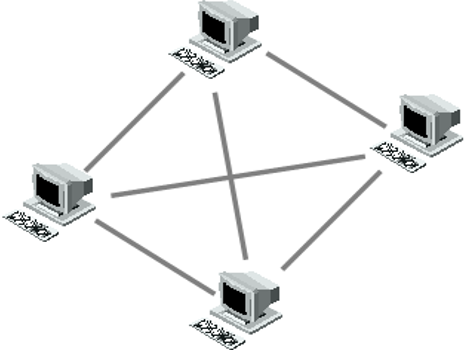
In a mesh topology, each device/PC is connected to every other device/PC in the network by its own dedicated cable. A network with ‘n’ nodes, will need n(n-1)/2 links to connect form a mesh topology. The below figure has 4 nodes, which means it will require 6 dedicated links to form a mesh topology.
Advantages of this topology :
- Mesh topology boasts the highest fault tolerance of all of the network topologies as data is transferred among the devices through dedicated channels or links.
- More security and privacy
Disadvantages of this topology :
- Installation and configuration are difficult.
- Since each connection needs its own cable a Mesh topology can get very expensive.
- Cost of maintenance is high.
b) Star Topology :
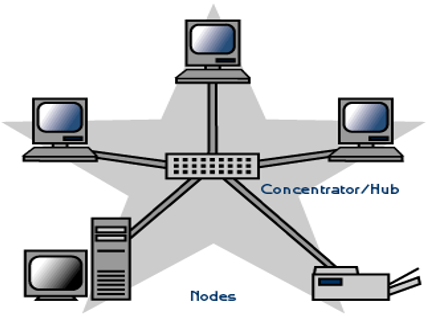
A physical Star topology connects the devices via a centralized unit such as a Hub or Switch. Nodes communicate across the network by passing data through this central device/unit.
Advantages of star topology :
- Single computer failure doesn’t bring down the whole network.
- Adding new devices to a Star network is very simple compared to in any other topologies.
- When connecting or removing devices, no disruptions occur.
- Centralised network/hub monitoring
- Easy to troubleshoot
Disadvantages of this topology :
- If the central device fails, then the whole network fails.
- Compared to the bus topology, a star network generally requires more cable.
- Star topology is more expensive than linear bus topologies because the cost of the central device is high.
c) Bus Topology :
In Bus topology, all devices are connected to a central cable, called the bus or backbone. Both ends of the network must be terminated with a terminator. A barrel connector can be used to extend the network. The backbone functions as a shared communication medium. Device wanting to communicate with another device on the network sends a message onto the backbone. The message is heard by all stations, but only the intended recipient actually accepts and processes the message. Terminator absorbs frames at end of medium

Example:
In the below example, Station C want to transmit a frame of data to station A.

Advantages of this topology :
- Simple, easy to use and construct
- Requires least amount of cable (less expensive)
Problems with this topology :
- A faulty cable will take the entire LAN down
- Difficult to troubleshoot
- Heavy network traffic can slow bus considerably
d) Ring Topology :
In this topology, all devices are connected to one another in the shape of a closed loop, so that each device is connected directly to two other devices, one on either side of it. Data is passed one way from device to device. A short message (called a token) is circulated around the ring, being passed from station to station. The token originates from a controller or master station which inserts it into the ring. A station which wants to transmit waits for the token to arrive. When the token arrives, the station changes it from a token to a connector message and appends its message. This new message is then placed on the outgoing side of the ring.
Each station passes on received tokens if they have nothing to transmit. They monitor connector messages to see if the message is addressed to them. If connector messages are addressed to them, they copy the message, modify it to signify its receipt, then send it on around the ring. Connector messages which are not addressed to them are passed directly on to the next station in the ring. When the connector message travels full circle and arrives at the original sending station, it checks the message to see if it’s been received. It then discards the message and replaces it with a token.

Advantages of this topology :
- Equal access for all users
- Perform well under heavy traffic
Disadvantages with this topology :
- If one device/cable fails then the whole network goes down.
- Difficult to troubleshoot
e) Hybrid Topology :
Hybrid means that there is more than one topology exist
Example: Stared Bus where groups of star-configured networks are connected to a linear bus backbone.

Advantages of this topology:
- Network expansion is simple
Disadvantages of this topology:
- If hub fails connections between the failed hub and other hubs will also fail.